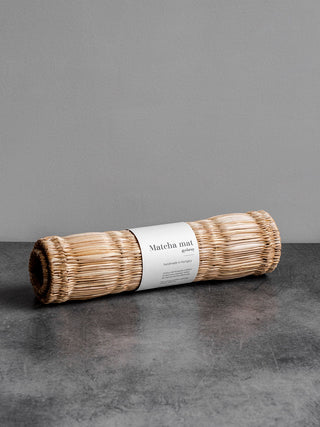
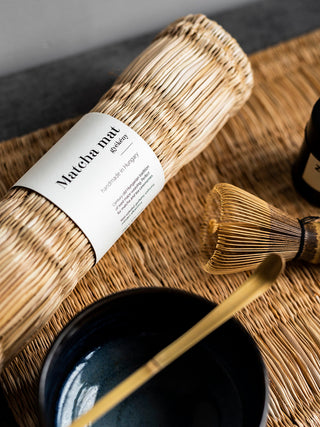
A brief introduction to how to make the most of your Matcha powder and what we need for preparation.
Accessories
The four vital accessories are:
- chashaku (茶杓), a thin bamboo scoop;
- chawan (茶碗), a ceramic bowl;
- chasen (茶筅), a tea whisk, also made of bamboo;
- and a sieve.
All of the necessary accessories are available in our shop, also online.
The chawan was especially made for us by Kezemura Pottery Budapest.
Preparation


Before touching the tea, we should pour hot water into the chawan to warm it up and soak the chasen, also in hot water, to tenderize the whisk’s threads. Then comes the tea. First, the powder needs to be sifted, as it tends to form small lumps that prevent even mixing. This is a very important step, if not the most important one, for the sifted tea makes two to three times as much foam as an unsifted one.

Now, 80 ml of 85C water should be added to 2 grams of the sifted matcha powder and mixed with gentle 8-shaped movements into a homogeneous substance.

Then, with quick hand movements, as though whipping egg whites, the tea is to be beaten into a foam, similar to milk foam.

The result is an emerald-colored, smooth liquid with a rather intense greenish flavor and a sweet, light, jade-like foam – the bigger the foam, the better the tea.
In our teashop at Lánchíd utca, Budapest, we are ready to prepare our Matchas for our guests, you can also learn the making method from us here.
____
History of Matcha
Contrary to popular belief, consuming tea as a stone-ground powder is not an exclusively Japanese tradition. During the Song dynasty (960-1279), this tea-drinking custom enjoyed great popularity in China. And it just happens that the well-known Eisai priest, who is credited with introducing tea and zen to Japan after his trip to China at the end of the 12th century, also prepared the tea in this method – and so began the history of Japanese matcha, the finely ground powder of shade-grown green tea.
On the tea market, there are two categories of matchas: culinary and ceremonial. Despite our myriad connections to gastronomy, we exclusively focus on ceremonial matcha. This category can be divided into two further subcategories: Usu-cha (薄茶) or thin tea, and Koi-cha (濃茶) depending on the amount of matcha powder being used. In tea ceremonies, matcha is prepared in both styles. Usu-cha serves as an “aperitif” to enhance the importance of Koi-cha. While the first one is usually served one chawan per person, the latter, being a highly appreciated beverage, is shared by three or four people.
Traditionally, Usu-cha and Koi-cha were not only different in preparation but also in quality. The high-grade koi-cha was wrapped in paper and stored in porcelain vessels, and the low-grade usu-cha served as a seal to provide good conditions for the koi-cha.

Ready to prepare your own bowl? Explore our matcha collection to find a tea for your daily ritual.